
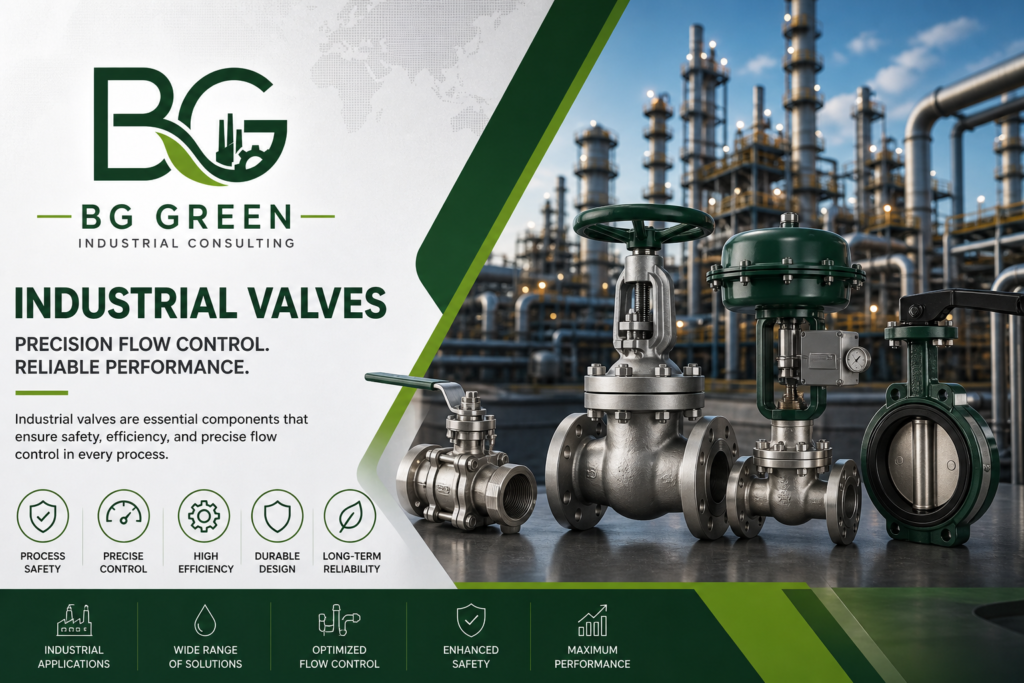
Industrial valves are essential components used to control the flow of liquids, gases, and steam within a system. They regulate, direct, or completely stop the flow in pipelines and process systems, making them a critical part of industrial operations.
A properly selected valve ensures process safety, efficiency, and precise flow control.
⚙️ What Is an Industrial Valve?
An industrial valve is a mechanical device that opens, closes, or partially obstructs passageways in piping systems to control fluid flow.
📌 In simple terms:
Valve = flow control + pressure regulation + system safety
🔄 The Role of Valves in Industrial Systems
Valves are used to:
Start or stop fluid flow
Regulate pressure and flow rate
Protect equipment from overload
Direct flow between different system paths
They are found in almost every industrial process system.
📊 Main Types of Industrial Valves
Industrial valves are categorized based on function and design.
🔵 1. Ball Valves
Ball valves use a rotating ball to control flow.
Features:
Quick open/close operation
Tight sealing capability
Low pressure drop
Applications:
Water systems
Oil and gas pipelines
General industrial applications
📌 Best for on/off control applications.
🔺 2. Gate Valves
Gate valves control flow using a sliding gate mechanism.
Features:
Fully open or fully closed operation
Minimal flow resistance
Suitable for large pipelines
Applications:
Water distribution
Industrial piping systems
📌 Not suitable for flow regulation.
🔄 3. Globe Valves
Globe valves are designed for precise flow regulation.
Features:
Excellent throttling capability
Accurate flow control
Higher pressure drop compared to other types
Applications:
Cooling systems
Steam control systems
Process industries
🌀 4. Check Valves (Non-Return Valves)
Check valves allow flow in only one direction.
Features:
Prevents backflow
Automatic operation
Protects pumps and equipment
Applications:
Pump discharge lines
Water systems
Chemical processes
⚙️ 5. Control Valves
Control valves automatically regulate flow based on system signals.
Features:
Automated operation
High precision control
Integrated with sensors and transmitters
Applications:
Process automation systems
Chemical industries
Power plants
📌 Used in advanced industrial control systems.
🧪 6. Butterfly Valves
Butterfly valves use a rotating disc to regulate flow.
Features:
Compact design
Lightweight structure
Fast operation
Applications:
HVAC systems
Water treatment
Large diameter pipelines
🔧 How to Select the Right Industrial Valve?
Valve selection depends on several key factors:
Type of fluid (liquid, gas, corrosive media)
Pressure and temperature conditions
Required flow control (on/off or modulation)
Pipe size and system design
Automation requirements
⚠️ Common Mistakes in Valve Selection
❌ Using wrong valve type for flow control
❌ Ignoring pressure and temperature limits
❌ Poor material selection for fluid compatibility
❌ Not considering automation integration
📌 Conclusion
Industrial valves are critical for safe and efficient process control. Whether using ball valves, gate valves, globe valves, check valves, control valves, or butterfly valves, each type serves a specific function in industrial systems.
Proper valve selection ensures:
✔️ Accurate flow control
✔️ System safety
✔️ Energy efficiency
✔️ Long-term reliability
🛠️ Our Services
Industrial valve sourcing
System design support
Technical selection consultancy
Procurement and logistics management
🌍 Leading Global Manufacturers in Industrial Valve Technologies
Industrial valve solutions are produced by globally recognized manufacturers specializing in flow control, process engineering, and industrial automation systems.
Some of the world’s leading companies in this field include:
Danfoss
Emerson
Flowserve
Schlumberger (Cameron)
Baker Hughes
AVK Group
KSB
Spirax Sarco
Velan
Crane Co.
IMI plc
Metso (Valmet)
Samson AG
Alfa Laval
Parker Hannifin
Honeywell
KITZ Corporation
Neway Valve
Bray International
Pentair
👉 Contact us for the most suitable valve solutions for your industrial applications.
All brand names mentioned are for reference purposes only. BG Green Industrial Consulting is an independent supplier and is not officially affiliated with these manufacturers.