
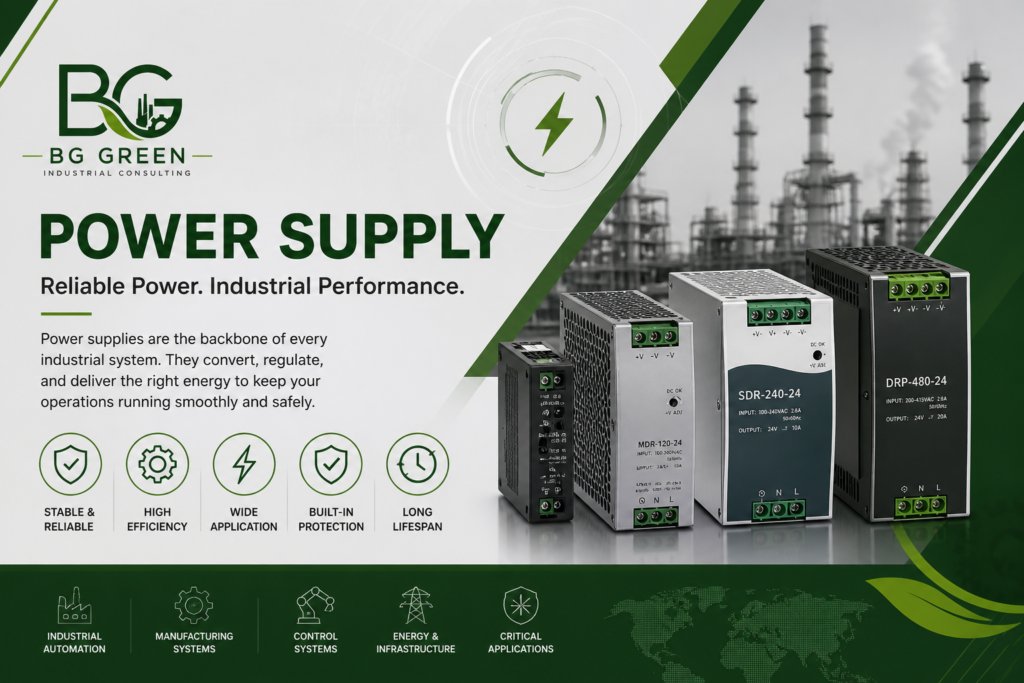
A power supply is a fundamental component that provides electrical energy to industrial systems and devices. It converts electrical power from a source into the correct voltage, current, and frequency required by equipment.
A properly selected power supply ensures system stability, safety, and long-term performance.
⚙️ What Is a Power Supply?
A power supply is an electrical device that converts and regulates power to meet the requirements of connected equipment.
📌 In simple terms:
Power Supply = energy conversion + voltage regulation + system protection
🔄 The Role of Power Supplies in Industrial Systems
Power supplies are used to:
Convert electrical energy into usable form
Provide stable and regulated output voltage
Protect systems from voltage fluctuations
Ensure continuous and reliable operation
Support automation and control systems
They are essential in all modern industrial and electronic applications.
📊 Main Types of Power Supplies
🔌 1. AC-DC Power Supplies
AC-DC power supplies convert alternating current (AC) into direct current (DC).
Features:
Widely used in industrial systems
Stable DC output
Available in various voltage and current ratings
Applications:
Control panels
Industrial automation
Electronic devices
📌 The most common type used in industry.
🔋 2. DC-DC Converters
DC-DC converters adjust one DC voltage level to another.
Features:
High efficiency
Compact design
Precise voltage regulation
Applications:
Battery-powered systems
Embedded electronics
Renewable energy systems
⚡ 3. Linear Power Supplies
Linear power supplies use transformers and linear regulation to provide clean output.
Features:
Low noise output
Simple design
High reliability
Applications:
Sensitive electronic equipment
Laboratories
Audio systems
📌 Ideal where low noise is critical.
🌀 4. Switching Power Supplies (SMPS)
Switch-mode power supplies use high-frequency switching to regulate power.
Features:
High efficiency
Lightweight and compact
Wide input voltage range
Applications:
Industrial automation
Telecommunications
IT equipment
📌 Most widely used modern power supply type.
🔄 5. Uninterruptible Power Supplies (UPS)
UPS systems provide backup power during outages.
Features:
Instant power backup
Protects against data loss
Voltage stabilization
Applications:
Data centers
Critical industrial systems
Hospitals
⚙️ Essential for mission-critical operations.
🔧 How to Select the Right Power Supply?
Power supply selection depends on several key factors:
Input voltage range (AC or DC)
Required output voltage and current
Power rating (Watt)
Efficiency requirements
Environmental conditions
Protection features (overvoltage, short circuit, thermal)
Mounting type and form factor
⚠️ Common Mistakes in Power Supply Selection
❌ Undersizing power capacity
❌ Ignoring efficiency and heat dissipation
❌ Not considering voltage fluctuations
❌ Poor protection feature selection
❌ Using unsuitable type for the application
📌 Conclusion
Power supplies are critical components for delivering stable and reliable energy in industrial systems. From AC-DC converters to SMPS and UPS systems, each type serves a specific function depending on application needs.
Proper power supply selection ensures:
✔️ Stable operation
✔️ Equipment protection
✔️ Energy efficiency
✔️ Long system lifespan
🛠️ Our Services
Industrial power supply sourcing
Technical selection consultancy
System design support
Procurement and logistics management
🌍 Leading Global Manufacturers in Power Supply Technologies
Industrial power supply solutions are developed and manufactured by globally recognized companies with proven expertise in automation, electronics, and energy systems.
Some of the world’s leading manufacturers in this field include:
Advanced Energy
Siemens
Schneider Electric
ABB
Phoenix Contact
Mean Well
Delta Electronics
TDK-Lambda
Omron
Mitsubishi Electric
Rockwell Automation (Allen-Bradley)
Eaton
Emerson
XP Power
Murata Power Solutions
Vicor
Cosel
Bel Power Solutions
RECOM Power
Traco Power
👉 Contact us to find the most suitable power supply solutions for your industrial applications.
All brand names mentioned are for reference purposes only. BG Green Industrial Consulting is an independent supplier and is not officially affiliated with these manufacturers.